
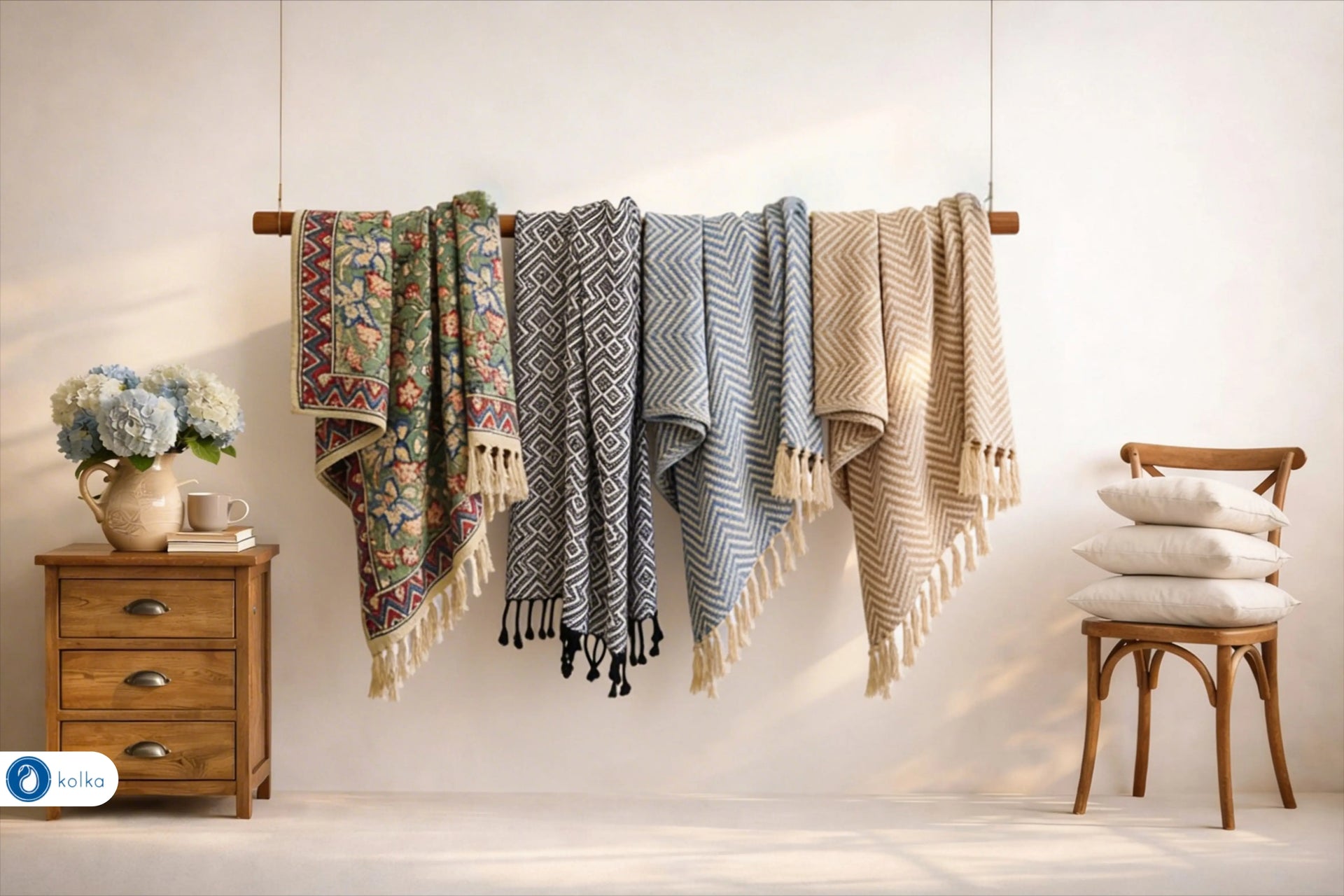
Most Australians reach for a throw when evenings start cooling — not because it’s cold, but because 20°C in Sydney and 15°C in Melbourne is that in-between temperature where a blanket feels too heavy and nothing feels insufficient. This is exactly where cotton throws work best.
This guide covers why cotton specifically suits Australian autumn, what the difference between weave types means in practice, how to layer by city, and which colours work this season.
Why Cotton Works for Australian Autumn
Wool, fleece and synthetic throws all have a place — but not in April and May across most of Australia.
Wool generates more warmth than the season requires. Sydney averages 20°C during the day and 14°C overnight in April. Melbourne sits at 15–17°C through the day and drops to around 10°C at night. A wool throw works for deep winter — at autumn temperatures it overheats quickly and most wool requires hand washing or dry cleaning, making it impractical for everyday sofa use.
Fleece and acrylic trap heat unevenly. They feel warm initially but don’t breathe — you either push them off or feel clammy underneath. As Freedom’s throw buying guide notes, lightweight materials like cotton work for warmer months and transitional seasons. Fleece and sherpa are for deep winter.
Cotton breathes. The cellular structure of natural cotton fibres allows air to circulate, so a cotton throw regulates temperature rather than just trapping heat. You stay comfortable through the full range of autumn evening temperatures — 10°C to 20°C — without overheating. It also softens with every wash, unlike synthetics that pill and stiffen over time.
Handwoven cotton specifically — like Kolka’s handloom cotton throw range — has an open weave structure from the loom process that increases breathability further. Hand-weaving creates slight irregularities in the weave that add visual texture while maintaining airflow. That is why a handwoven cotton throw looks richer draped on a sofa than a plain machine-made alternative.
Cotton Throws by Weave — What the Difference Actually Means

Not all cotton throws perform the same way. Weave type determines warmth level, texture, and how the throw sits on a sofa — and this matters more than weight alone.
Handloom weave — chevron, stripe, check patterns
Woven on a hand loom, these have a slightly open, irregular weave that breathes freely. Best for Sydney, Brisbane and Perth through April and May where evenings don’t drop below 13–14°C. Kolka’s beige chevron handloom throw and graphite handloom throw sit in this category — lightweight, drapeable, machine washable.
Tightly woven cotton — block print or botanica prints
A tighter weave holds more warmth by reducing airflow between fibres. Better suited to Melbourne, Canberra and the ACT where May nights drop to 8–10°C. Kolka’s green botanica throw rug and grain sack rose throw fall here — more warmth, same machine-washable natural cotton.
What the difference looks like on a sofa
A handloom weave drapes softly and creates natural folds — it looks casually styled even when just dropped over an armrest. A tighter woven throw sits more structured — better for a deliberately folded, polished look across a sofa back. Both are 120x170cm in Kolka’s range — large enough to cover one person from lap to shoulder when seated.
For a full breakdown of how throws work alongside quilts and cushions as a layering system, the Kolka art of layering guide covers the complete approach.
How to Layer a Cotton Throw for Autumn — by City
This is where most throw guides stop short. “Use a throw on your sofa” is not useful if you live in Melbourne in May versus Sydney in April. The temperature difference between cities matters.
Sydney, Brisbane, Perth — April and May
A single cotton throw on a sofa handles evenings comfortably. Days at 20–22°C and nights at 13–15°C sit within cotton’s natural range. One handloom throw over a sofa arm, pulled up when needed, is enough through most of autumn without adding layers.
On the bed — a cotton throw folded across the foot of the bed works as the first extra layer before moving to heavier bedding. It pairs naturally with a kantha or quilted cotton bedspread as the base — pull the throw up when the room cools overnight.
Melbourne, Canberra, ACT — April into May
By late April Melbourne days sit at 15–17°C and nights at 9–11°C. A single cotton throw works for April evenings but starts to feel light by May nights. The practical approach: cotton throw on the sofa for the evening, a heavier blanket stored nearby for late nights when temperature drops further.
On the bed — pair a cotton throw at the foot with a quilted cotton bedspread underneath. The combination handles most of Melbourne’s autumn range without switching to full winter bedding. When May nights drop below 10°C, add the throw over the bedspread rather than replacing it.
Adelaide and Tasmania — variable
Adelaide autumn is similar to Melbourne — cotton throw through April, start layering from May. Tasmania drops colder earlier — by April nights a tightly woven cotton throw works but may need a second layer by late April in Hobart, where overnight temperatures approach 8°C.
For a full bedroom layering guide by season, Kolka’s art of layering cushions, throws and quilts covers the complete setup room by room.
Autumn Colour Pairings — Throw with Sofa and Cushions

The KAS Australia Autumn 2026 Home Styling Guide confirms this season’s palette as rust, clay, terracotta, olive, moss, sage, warm beige and cream. The simplest rule: pick one colour already in your sofa or cushions and go one shade warmer or deeper for the throw.
Grey sofa
Beige chevron handloom throw + blush pink or sage green cushion covers. The warm beige lifts the cool grey without competing. For full cushion colour ideas, the Kolka grey sofa cushion guide covers every shade of grey.
Beige or neutral sofa
Green botanica throw + olive or warm white cushion covers. Botanical green against a warm neutral reads as intentional and seasonally right for autumn.
Brown leather sofa
Beige chevron handloom or grain sack rose throw draped across the sofa back — leather gets cold to sit against in autumn and a cotton throw across the full back solves this. The Kolka brown leather sofa cushion guide has complementary cushion combinations.
Dark or charcoal sofa
Graphite handloom throw + terracotta or mustard cushion covers. The graphite throw creates texture in a similar tone — the cushion covers carry the autumn colour.
Cream or white sofa
Grain sack rose throw + country pink or blush cushion covers. Warm rose tones against white read fresh for early autumn and shift naturally into deeper winter tones as the season progresses.
Care
• Washing: Machine wash gentle cold cycle, mild detergent. Wash separately for first two washes.
• Drying: Air dry flat or on a line in shade. No tumble drying — heat causes shrinkage. Do not wring.
• Softening: Cotton softens naturally with each wash. Add half a cup of white vinegar to the rinse cycle to accelerate. Do not use fabric softener — it coats fibres and reduces breathability.
• Storage: Fold loosely in a cotton bag or pillowcase. Avoid sealed plastic — cotton needs airflow.
• Variation: Slight irregularity in weave and colour is inherent in handwoven cotton — characteristics of handmade production, not defects. Full care details at the Kolka FAQ page.
Free shipping Australia-wide on all orders over $200.
FAQs
1. Are cotton throws warm enough for Australian autumn?
Yes, for most of Australia through April and May. Sydney’s 14–20°C and Melbourne’s 10–17°C autumn range sits within what natural cotton handles comfortably. By late May in Melbourne and Canberra when nights drop to 8–10°C, a single cotton throw starts to feel light on a sofa — layer it with a heavier blanket or use it over a quilted bedspread on the bed.
2. What is the difference between a cotton throw and a cotton throw rug?
In Australia the terms are used interchangeably by most retailers. Technically a throw rug is slightly larger and heavier — designed to function as a furniture or floor covering as well as a wrap. A throw is lighter and primarily a sofa or bed accent. Kolka’s handloom throw rugs at 120x170cm sit at the larger, more functional end.
3. Can I machine wash a cotton throw?
Yes. Kolka’s cotton throws are machine washable on a gentle cold cycle with mild detergent. Wash separately for the first two washes. Air dry in shade — do not tumble dry or bleach. The throw softens with each wash. Avoid fabric softener as it reduces the natural breathability of cotton.
4. What size cotton throw do I need for a sofa?
A 120x170cm throw covers one person from lap to shoulder when seated. For a two-seater drape or to cover a full sofa back, 150x200cm or larger works better. For the foot of a queen bed, 120x170cm is adequate — it covers the lower third with some drape on both sides.
5. Is a handwoven cotton throw better than a regular cotton throw?
For autumn sofa use in Australia, yes — for two reasons. First, the open hand-loom weave breathes more freely than machine-knitted cotton, which matters at 15–20°C. Second, handwoven throws drape more naturally on a sofa arm because the weave has slight variation — it folds softly rather than sitting stiffly. Slight weave variation is inherent in handmade production and is a characteristic, not a flaw.